How Mixed Tablet Sizes Affect Tablet Counting Accuracy and Quality Control
When pharmaceutical products vary in size, shape, thickness, or surface characteristics, maintaining consistent counting accuracy becomes more demanding. A tablet counting machine must not only identify individual products correctly but also manage differences in product flow, spacing, and detection conditions. For manufacturers handling multiple formulations or frequent product changes, these factors directly influence filling accuracy, production stability, and quality control.
As a pharma machine manufacturer, Pharmapack develops counting and filling solutions around these practical production requirements. Our approach combines precision counting technology, modular machine architecture, abnormal product detection, and experience in integrating complete packaging lines.
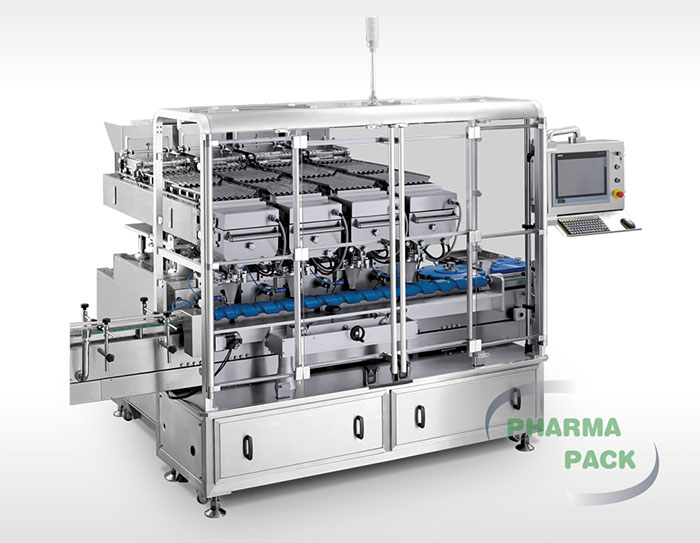
Why Mixed Tablet Sizes Can Affect Counting Accuracy
Tablet counting depends on the machine’s ability to separate products and detect each individual piece as it passes through the counting area. When tablet dimensions change, the way products move through feeding channels can also change.
Larger or thicker tablets may require different feeding conditions from smaller tablets. Differences in shape can affect orientation and spacing, while products with smooth or irregular surfaces may behave differently during vibration and transfer. If products overlap or enter a detection area too closely together, the possibility of missed counts or repeated detection can increase.
Pharmapack counting systems use controlled feeding and dedicated detection technology to help products move through channels in a more consistent manner. For example, the LFM series uses multi grade vibratory plates to guide tablets and capsules into individual channels, while electronic sensors detect products as they pass through the counting tunnels.
This makes product testing and parameter adjustment important when introducing a new tablet size or formulation. Counting accuracy should be evaluated under actual production conditions rather than based only on the nominal specifications of the machine.
Precision Detection Goes Beyond Counting
Accurate counting is only one part of quality control. A modern tablet counting machine can also contribute to the identification and rejection of abnormal products before they reach the final container.
Broken tablets, defective pieces, overlapping products, or other irregular items can create quality risks even when the numerical count is correct. Pharmapack’s inspection solutions combine counting with visual detection and rejection technologies. Our 360 Counting & Sorting Machine, for example, uses cameras positioned around the product flow to inspect tablets and capsules from multiple angles, while an integrated rejection system removes detected defects from the production flow.
This approach connects counting accuracy with product integrity. Instead of treating counting and inspection as completely separate processes, manufacturers can incorporate detection into the packaging line and establish additional quality checkpoints during operation.
For applications requiring higher levels of process monitoring, Pharmapack systems can also provide fault diagnosis, real time monitoring, and alarm functions. These capabilities help operators identify abnormal operating conditions before they develop into larger production issues.
Modular Design for Different Tablet Requirements
Product variation is a common consideration when selecting pharmaceutical packaging equipment. A machine configured for one product may need to accommodate different tablet dimensions, filling quantities, container formats, or production speeds over its operating life.
This is where modular design becomes particularly useful. Pharmapack’s PP Modular Series is designed with independently configured modules, allowing the counting system to be adapted according to production requirements. Depending on the model, different module configurations can support changes in capacity and production speed without requiring an entirely different machine architecture.
The modular structure also supports maintenance and cleaning. Independent modules and accessible product contact areas can simplify inspection and reduce the complexity associated with routine servicing. Pharmapack’s counter solutions are designed with relatively few change parts, and selected models support tool less changeover to make product transitions more efficient.
For manufacturers handling multiple tablet sizes, this flexibility can be an important consideration because equipment needs may evolve as product portfolios and production requirements change.
Quality Control Across the Complete Packaging Line
Counting accuracy should not be evaluated in isolation. Feeding, counting, filling, bottle handling, inspection, rejection, and downstream packaging all influence the final result.
Pharmapack approaches tablet counting as part of an integrated packaging process rather than as a standalone operation. Its counter portfolio includes systems that can combine counting, filling, inspection, sorting, and weighing functions, depending on the application. The company also provides turnkey services covering system design, commissioning, installation, training, maintenance, and equipment upgrades.
This line level experience is particularly relevant when production involves multiple tablet formats. Instead of evaluating counting accuracy separately from the rest of the process, engineers can consider how product characteristics interact with the complete material flow and packaging sequence.
Choosing a Tablet Counting Machine for Mixed Products
When comparing tablet counting machines, production teams should look beyond maximum counting speed. The more important questions include how the system handles different product dimensions, how counting accuracy is verified, how defective products are identified, and how easily the machine can be adjusted when production requirements change.
Pharmapack offers counter models covering different production capacities and product ranges. For example, the LFM-16C supports tablets, capsules, caplets, soft gels, and transparent soft capsules within specified size ranges, while the LFM-32 provides a higher capacity modular configuration with optional inspection capabilities.
A suitable system should therefore be selected according to actual product characteristics, required output, container specifications, inspection requirements, and the configuration of the existing packaging line.
Building More Consistent Counting and Quality Control
Mixed tablet sizes do not automatically mean unstable counting performance, but they do increase the importance of controlled product handling, reliable detection, and flexible machine configuration. Precision counting technology provides the foundation, while abnormal product detection and process monitoring add further layers of quality control.
With experience in tablet and capsule counting, modular equipment design, inspection systems, and complete packaging line integration, Pharmapack develops solutions that address these requirements from both the machine and production line perspectives. By evaluating product characteristics before equipment selection and matching the counting system to the wider packaging process, manufacturers can establish a more consistent approach to accuracy, inspection, and quality control.