How to Choose the Right Sensor for Transparent Labels on Round Bottles
Transparent labels create a clean and premium appearance, but they also introduce specific challenges for automated labeling. Unlike opaque labels, transparent materials can allow light to pass through, making it harder for conventional sensors to identify label gaps accurately. For manufacturers handling round bottles, the choice of sensor can directly affect label positioning, production consistency, and changeover efficiency.
At Pharmapack, we consider sensor performance an essential part of the overall labeling system. As a labeling equipment manufacturer, we design labeling solutions around the interaction between the bottle, label material, sensor, and dispensing mechanism rather than treating each component separately.
Why Transparent Labels Require Careful Sensor Selection
A standard label sensor detects the difference between the label material and its backing paper. With opaque labels, this difference is generally easy to identify. Transparent labels, however, may have similar optical properties to the liner, particularly when the label has a small gap, low contrast, or special coating.
This can result in missed label detection, inaccurate dispensing signals, or inconsistent spacing between labels. On a high speed production line, even a small detection error can become a repeated labeling problem.
For this reason, sensor selection should be based on the actual label construction rather than simply the bottle size or machine speed. Label transparency, liner material, label gap, thickness, surface treatment, and printing characteristics can all influence detection performance.
Optical Sensors and Transparent Label Detection
Optical sensors are commonly used in automatic labeling equipment because they can detect changes in light transmission or reflection. However, not every optical sensor performs equally well with transparent materials.
For transparent labels, the sensor needs to distinguish between the label and the backing material with sufficient reliability. The sensor's sensitivity and detection method therefore become important considerations.
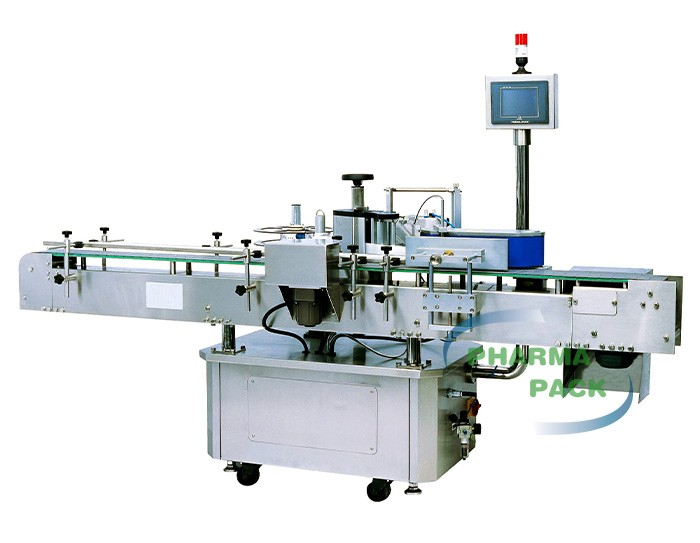
At Pharmapack, our labeling systems incorporate sensor control into the label dispensing process. In the LFLB-1120 vertical round bottle labeling machine, a product sensor detects the incoming bottle and triggers label dispensing, while a separate label sensor controls the movement of the label material. This coordinated detection process helps maintain consistent label feeding during operation.
For applications involving different label materials, adjustable sensor sensitivity can also provide greater flexibility. Pharmapack's labeling equipment includes sensor solutions designed to accommodate labels with different transmissivity, reducing the need for frequent mechanical adjustments when label specifications change.
Match the Sensor to the Round Bottle Application
Sensor selection should not be considered independently from the bottle itself. Round bottles require controlled positioning because the label needs to follow a curved surface smoothly. Bottle diameter, height, material, surface finish, and spacing between containers can all influence detection and application.
A properly configured round bottle labeling machine coordinates bottle detection, label dispensing, and label wrapping. Pharmapack's LFLB-1120, for example, uses a bottle separator to control bottle spacing before the product sensor signals the labeling process. Its side conveyor further supports labeling performance as the bottle passes through the application area.
This approach is particularly useful when production involves multiple bottle sizes. The LFLB-1120 supports round containers from 16 mm to 120 mm in diameter and can store up to 50 job settings for different bottle and labeling requirements.
Consider Changeover and Production Requirements
A sensor may perform well under one set of conditions but become less practical if operators need to reposition or recalibrate it every time the label changes. For facilities running multiple products, easy changeover can be just as important as initial detection accuracy.
Pharmapack's LFLB-1120 is designed so that sensors do not need to be repositioned when changing bottle or label sizes. Its servo driven labeling head and dual roller structure support controlled label dispensing, while the programmable controller facilitates communication with upstream equipment.
When evaluating labeling equipment, it is therefore useful to consider not only whether the sensor can detect a transparent label, but also how easily the complete system can adapt to new products.
Pharmapack's Approach to Labeling Equipment
As a labeling equipment manufacturer, Pharmapack develops different labeling configurations for round bottles, vials, ampoules, syringes, and other containers. Our portfolio includes vertical, horizontal, rotary, and other automatic labeling solutions, allowing equipment selection to reflect container geometry and production requirements.
For transparent labels, we focus on the complete detection and dispensing process. Sensor configuration, label material, bottle characteristics, application method, and production speed all need to work together. This approach allows the labeling system to address the practical conditions of the production line rather than relying on a one size fits all configuration.
A Practical Approach to Transparent Labeling
Choosing a sensor for transparent labels starts with understanding the actual labeling materials and production conditions. Before selecting a round bottle labeling machine, manufacturers should evaluate label transparency, liner characteristics, bottle dimensions, required speed, label position, and expected product changeovers.
At Pharmapack, we use these parameters to help configure suitable labeling solutions. With the right sensor and dispensing system, transparent labels can be handled with consistent detection and controlled application, supporting reliable production across different round bottle formats.