How Capsule Shell Types Influence Tablet Counting Machine Performance
When selecting a tablet counting machine for capsules, it is easy to focus on counting speed, sensor accuracy, and filling capacity. Yet the physical characteristics of capsules also have an important influence on how products move through the machine. Hard capsules, softgels, and transparent soft capsules can differ in shape, surface characteristics, weight, and flexibility, which can affect feeding, separation, detection, and filling.
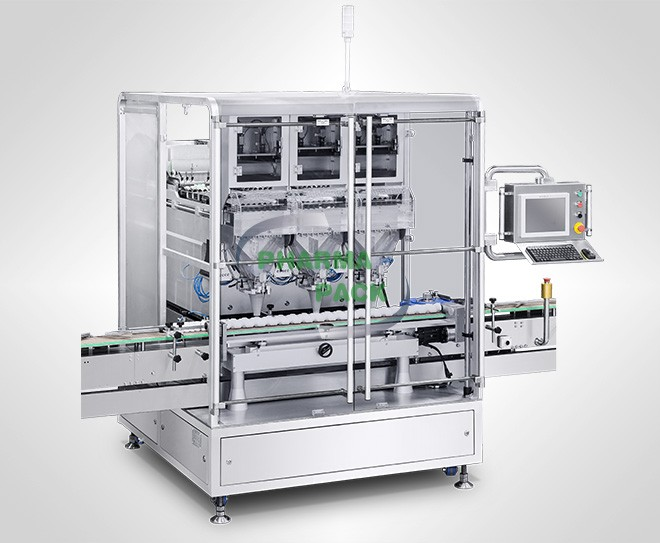
At Pharmapack, we consider product characteristics as part of the overall counting process. Our tablet counting machine solutions are designed to handle tablets, hard capsules, softgels, and transparent soft capsules, with different configurations available according to product dimensions and production requirements.
Why Capsule Shell Type Matters During Feeding
Before an automatic tablet counter can detect a capsule, the product needs to reach the sensing area in a controlled and separated flow. Capsule shell characteristics can influence how products move across vibratory feeding plates.
Hard capsules generally have a defined cylindrical shape and a relatively firm shell. Softgels can have a smoother surface and more flexible structure, while transparent soft capsules may have different surface and optical characteristics. These differences can affect how products slide, rotate, separate, and enter individual counting channels.
For this reason, a counting system designed for multiple product types needs more than a basic counting sensor. The feeding mechanism should provide appropriate control over product movement so capsules can enter the detection area in a consistent sequence.
Feeding Stability Supports Reliable Counting
In a tablet counting machine, feeding and detection work together. Pharmapack's LF series uses multi-level vibratory plates to move products continuously through dedicated channels. By adjusting vibration frequency, products can be guided into a single-file flow before reaching the detection tunnels. The LF-16, for example, uses two sets of three-grade vibratory plates and 32 channels for product separation and counting.
This process is particularly relevant when processing capsules because their shape and surface can affect movement on the feeding surface. If capsules do not separate consistently, products may arrive too close together or fail to enter the sensing area smoothly.
Controlling the feeding stage therefore helps create more consistent conditions for the sensors and control system. The goal is not simply to make products move faster, but to maintain an appropriate and repeatable product flow.
Matching the Machine to Capsule Dimensions
Shell type is only one part of capsule compatibility. Length, diameter, and overall product geometry also need to be considered when selecting an automatic tablet counter.
For example, Pharmapack's LF-16 supports products with a thickness of 3 to 10 mm, a diameter of 3 to 13 mm, and a length of 3 to 21 mm. The machine can process fill quantities from 1 to 1,000 pieces and is designed for applications across pharmaceutical, healthcare, and food industries.
For applications involving multiple capsule formats, modular equipment can provide additional flexibility. Pharmapack's LFM-32 supports tablets, capsules, caplets, softgels, and transparent soft capsules, with product dimensions and production requirements considered as part of the machine configuration. Its modular structure uses separate module heads, with eight channels per module, to support continuous counting.
This approach allows the equipment selection process to begin with the actual products rather than relying only on a standard machine specification.
Optical Detection and Capsule Characteristics
Once capsules have been separated into the counting channels, the detection system determines when each product passes through the sensing area. Capsule appearance can therefore become relevant, particularly when products differ in color, transparency, or external finish.
An automatic tablet counter should be evaluated according to the products it will process and the detection technology used by the specific machine. Pharmapack systems combine sensors with control systems to count products as they pass through dedicated detection tunnels.
For applications requiring additional inspection, Pharmapack also offers counting and sorting equipment that combines camera detection, rejection, and static weighing functions. This provides another approach for applications where counting and product inspection need to be considered together.
Consider the Complete Counting and Filling Process
Capsule counting does not end when the sensor registers the required quantity. The counted products must also be transferred into containers accurately and consistently.
In the LF-16 system, once the preset count is reached, the tunnel gate and nozzle gate coordinate the transfer of counted products into the bottle. The filled bottle is then released and the next container is positioned for filling. Product contact parts are made from 316 stainless steel and can be disassembled for cleaning.
For higher-volume applications, Pharmapack's modular counters integrate counting and bottling while supporting different configurations. The LFM-32, for example, is designed for tablets, capsules, caplets, softgels, and transparent soft capsules, with a stated maximum speed of up to 24,000 pieces per minute depending on the product being inspected.
Building the Right Capsule Counting Solution
Choosing a tablet counting machine for capsules requires looking beyond the shell material alone. Product dimensions, surface characteristics, feeding behavior, transparency, target count, container size, and required production speed all contribute to machine selection.
At Pharmapack, we use product information and production requirements to develop counting and filling configurations suited to different applications. Our equipment portfolio includes systems for tablets, hard and soft capsules, softgels, and other solid products, with options ranging from conventional counters to modular counting and inspection systems.
The right automatic tablet counter should provide a controlled path from feeding to detection and finally to bottle filling. By considering capsule shell type together with dimensions and production requirements, users can establish a more suitable foundation for stable counting performance. Pharmapack continues to develop tablet counting machine solutions around this complete process, helping production lines handle different capsule formats with controlled feeding, consistent detection, and efficient filling.