
Pharmaceutical counting machines have been widely adopted on solid-dose packaging lines for tablets, capsules, softgels, and other oral solid forms. Their counting accuracy is directly linked to product quality and regulatory compliance. However, as dosage forms become increasingly diverse, differences in shape, coating, fragility, and material properties create unique counting challenges for each type.
Therefore, choosing a suitable automatic counting machine has become critical for pharmaceutical manufacturers. In this blog, we will talk about the specific counting challenges associated with common dosage forms, providing a scientific selection guide.

Copyright photo from: https://www.freepik.com/
Different solid dosage forms vary significantly in their shapes, structural features, and surface properties. These physical attributes directly affect the stability of feeding, channeling, and optical detection during counting.
Tablets are one of the most widely used solid dosage forms and are typically manufactured in round, oval, or other shapes. Their surfaces may be sugar-coated or film-coated to improve stability, which are prone to generating dust and fragments during production.
These physical characteristics bring about several challenges for the tablet counter:
lGeometric differences affect how tablets orient and align on vibratory channels. Irregular shapes are more likely to overlap, jam, or rotate unpredictably, resulting in inconsistent feeding speeds.
lWhen tablets rub against channels or machine parts, the coating layer may be scratched—an issue that becomes more prominent under high-speed production conditions.
lIn addition, inevitable dust and fragments produced during tablet manufacturing can interfere with photoelectric sensors, causing miscounts, missed counts, or reduced detection accuracy. This increases the demand for stable optical systems and more frequent cleaning.
A major challenge during capsule counting is the separation of cap and body, which may lead to powder leakage and contamination of optical and feeding components. Furthermore, due to their lightweight nature, capsules tend to accumulate static charge, causing them to stick to channel walls or to each other, hindering smooth feeding.
Another common issue is the difficulty of detecting empty capsules. Visually, empty and filled capsules may appear similar, and without sufficient sensor sensitivity, miscounts or failure to reject empty capsules may occur.
Beyond conventional tablets and capsules, the market is increasingly adopting unique solid dosage forms such as heart-shaped tablets, specially designed tablets, mini-suppositories, and hybrid soft–hard formulations.
lThe heart-shaped or ellipsoid tablets tend to flip or shift during vibration due to unstable centers of gravity, while suppository-like forms may demand fully customized channels and track dimensions.
lHigh-potency drugs, on the other hand, require extremely stringent control of cross-contamination. This means the pharmaceutical counting machines must provide fast disassembly for cleaning, enclosed structures, and modular optical systems to achieve thorough isolation between products and comply with GMP requirements.
1. Dosage Form Compatibility
This is the core value of an automatic counting machine. Superior equipment should effortlessly handle products of different sizes, shapes, and characteristics, such as coated tablets, uncoated tablets, soft capsules, and hard capsules. The key lies in:
lChannel possesses the ability to prevent jamming, ensure smooth alignment, and avoid stacking.
lThe vibration bowl and discharge structure of the feeding system must be flexibly adjustable to adapt to the physical properties of different products, such as those with high dust, fragile tablets, or capsules prone to static electricity.
2. Speed and Accuracy Balance
High-speed production lines require the equipment to maintain excellent counting accuracy even under high throughput, ensuring no missed counts, no double counts, and no errors. This is achieved through:
lPrecise synchronous control of vibration feeding and discharge speed.
lThe stability and precision of high-performance photoelectric sensors in multi-channel detection.
lThe real-time performance and coordination of the servo linkage between bottle positions, channels, and gates.
3. Ease of Cleaning and Maintenance
An automated counting machine should support quick and thorough cleaning to minimize cross-batch contamination and changeover time. Our PHARMAPACK counters, for instance, feature a modular design that allows the counting unit to be disassembled independently. This enables rapid cleaning and maintenance, facilitates flexible switching between different products, and significantly reduces downtime.
4. Compliance and Contamination Control
Compliance is the entry ticket for equipment into the pharmaceutical production system. The pharmacy counting equipment must inherently possess designs that prevent cross-contamination, such as smooth channels with no sanitary dead ends, easy-to-clean structures, or enclosed designs. Taking our LF-16 Tablet/Capsule Counting Machine as an example, all product contact parts are manufactured from 316 stainless steel, fully complying with current and future GMP standards.
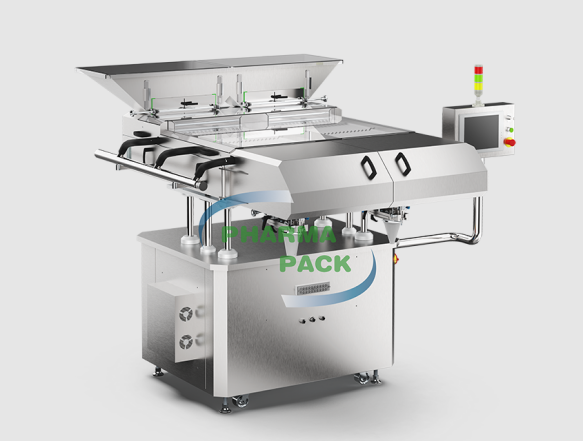
The LFM-24 automatic counting machine is designed for high-speed production lines with frequent product changeovers. It offers excellent product compatibility and handles relatively large items up to approximately 20 mm in size, making it suitable for special dosage forms such as large irregular tablets or mini-suppositories, effectively overcoming the common limitation of conventional equipment.
In this system, products are oriented through a vibration bowl and transferred into 24 independent channels, which virtually eliminates jamming, stacking, and alignment issues. Optical sensors perform real-time counting, and a servo-controlled gate ensures accurate discharge according to preset quantities. A bottle-positioning system further guarantees precise alignment. With a maximum output speed of about 18,000 pcs/hr, the machine fully meets the throughput demands of high-speed production lines.
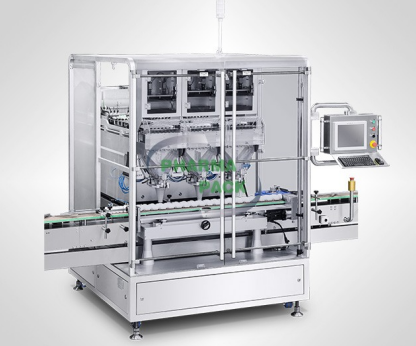
The LF-16 is a robust and reliable solution for medium to high-speed lines. It boasts two hoppers feeding 32 channels. Optical sensors perform real-time counting, and servo gates control the precise discharge of doses. An automatic bottle-changing cylinder enhances continuous operation. With minimal changeover parts, it simplifies upkeep. Its maximum throughput is approximately 16,000 pcs/min (based on total channel capacity).
In pharmaceutical packaging, where compliance and precision are essential, investing in the right automatic counting equipment is fundamental to securing consistent quality and operational reliability. Get in touch to see how we can support your quality goals and improve line efficiency.