How to Choose Automated Visual Inspection Systems for Sterile Injectables?
The production of sterile injectable medicines has become increasingly automated, yet product recalls related to visible particles, container defects, and filling abnormalities still occur. Because these products are administered directly into the human body through injection or infusion, even small quality deviations can have significant consequences.
As a result, automated visual inspection has become a critical part of sterile injectable manufacturing and pharmaceutical quality control.[1] Across the pharmaceutical industry, visual inspection is evolving from manual lamp inspection toward automated and intelligent systems.
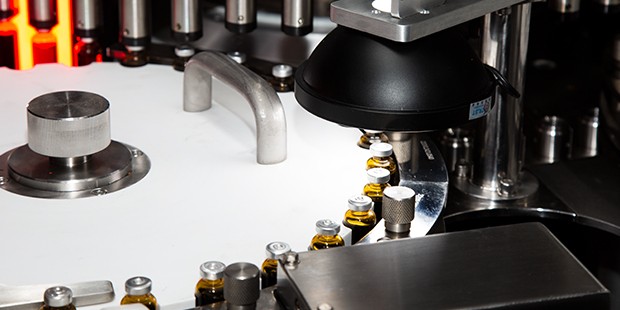
This article examines the key inspection challenges for sterile injectables and explains how PHARMAPACK can help manufacturers achieve reliable high-speed inspection with strong compliance support.
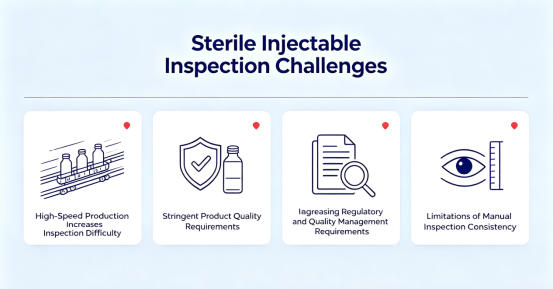
Sterile Injectable Inspection Challenges
As production speeds continue to increase, manufacturers face several inspection challenges that directly affect injectable packaging quality and pharmaceutical quality control.
1. High-Speed Production Increases Inspection Difficulty
Modern sterile injectable production lines continue to operate at higher speeds to improve manufacturing efficiency. Thousands of small ampoules or vials may pass through the inspection station every hour, making it difficult for manual inspection to keep pace consistently.
Inspection bottlenecks can reduce overall line efficiency, while missed defects or unnecessary rejects may increase production costs.
2. Stringent Product Quality Requirements
Even small defects can lead to batch rejection or market recalls, making pharmaceutical visual inspection a critical safeguard. According to an analysis of FDA sterile injectable drug recall notices published between 2017 and 2021, visible particles accounted for 33% of reported recall causes, making them the second-largest category after lack of sterility assurance at 35%.[2]
Because sterile injectables enter the human body through injection or infusion, manufacturers must maintain consistently high product quality while minimizing unnecessary rejects.
3. Increasing Regulatory and Quality Management Requirements
FDA cGMP regulations and EU GMP Annex 1 establish requirements related to production controls, inspection processes, data integrity, and the investigation and trending of quality defects.[3][4].
Manufacturers therefore require a visual inspection system that supports regulatory compliance while reducing documentation and quality management workload.
4. Limitations of Manual Inspection Consistency
Human inspectors are affected by fatigue, attention level, experience, and subjective judgment. These factors make it difficult to maintain consistent pharmaceutical visual inspection performance during long production runs, especially on high-speed manufacturing lines.[1]
What Quality Risks Should an Automated Visual Inspection System Cover?
A comprehensive visual inspection system for sterile injectables should address three major categories of quality risk.[1][4]
Drug solution quality inspection
l Visible foreign particles
l Abnormal solution appearance
l Turbidity
l Sedimentation
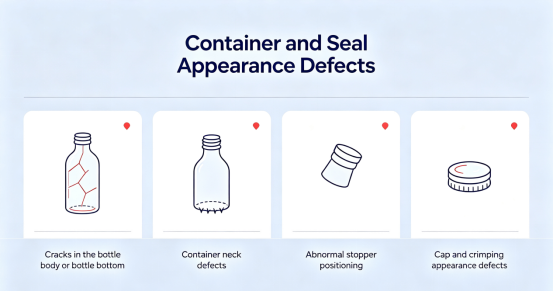
Container and seal appearance defects
l Cracks in the bottle body or bottle bottom
l Container neck defects
l Abnormal stopper positioning
l Cap and crimping appearance defects
Filling quality inspection
l Excessively high or low fill levels
l Empty containers
l Underfilled containers
How to Choose the Right Automated Visual Inspection System?
When selecting an automated visual inspection system for sterile injectable production, manufacturers should evaluate several key technical factors to ensure the equipment meets production, regulatory, and product protection requirements.
1. Detection Accuracy
A high-performance automated visual inspection system should be capable of detecting multiple defect types and identifying micron-level particles. AI deep-learning algorithms can help reduce false rejection rates and improve classification accuracy over time.
2. Inspection Speed
The system should operate continuously and stably under production conditions. Its maximum throughput must match or exceed the line speed to avoid creating a bottleneck in sterile manufacturing.
3. Container Compatibility
Manufacturers should verify compatibility with ampoules, vials, and other sterile injectable containers, as well as different container diameters, heights, and material types.[1][4]
4. Product Protection
The inspection process should not compromise the integrity of sterile injectable products or their containers. Stable conveying, controlled container rotation, gentle handling, and reliable reject separation can help reduce the risk of scratches, breakage, leakage, or unnecessary product loss, particularly when inspecting fragile ampoules, glass vials, or high-value injectable products.
5. GMP Compliance
Key compliance features include:
l Appropriate protection rating for washdown and cleaning
l Electronic records and audit trails compliant with FDA 21 CFR Part 11[5]
l Data traceability and defect history management
6. Production Line Integration
The system should provide reserved linkage interfaces at the discharge section and support connection with downstream equipment such as labeling machines and packaging systems for fully automated line operation.
ISPE's GAMP 5 guidance also recommends integrated and data-driven manufacturing systems to improve process reliability, traceability, and lifecycle management in pharmaceutical production.[6]
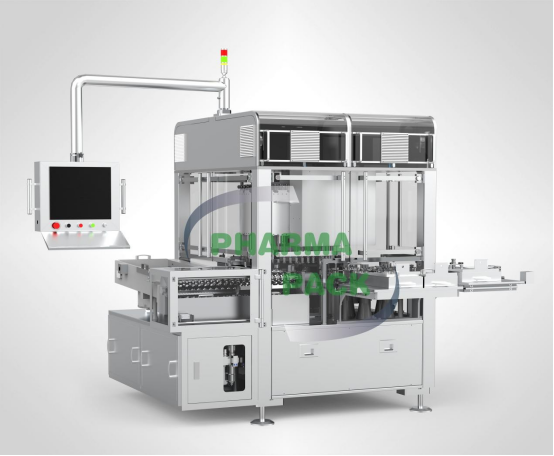
PHARMAPACK LFIM-48 Continuous Automatic Inspection Machine for Sterile Injectables
PHARMAPACK LFIM-48 Continuous Automated Visual Inspection Machine is designed for high-speed inspection of sterile liquid products and integrates AI-based machine vision with continuous rotary handling technology.
1. High Inspection Accuracy
The main rotary turret is equipped with six camera groups. The AI vision inspection system uses 1.2-megapixel HD industrial cameras combined with deep-learning algorithms and stroboscopic lighting technology, enabling reliable detection of particles and appearance defects.
2. High Inspection Speed
To keep pace with modern high-speed sterile filling lines and eliminate inspection bottlenecks, the LFIM-48 supports inspection speeds of up to 400 bottles per minute. Continuous operation helps manufacturers maintain stable throughput while improving production efficiency.
3. Wide Container Compatibility
The LFIM-48 supports containers with:
l Bottle diameter: 20–36 mm
l Bottle height: 40–120 mm
It is suitable for ampoules and vials, and it can also be extended for oral liquid bottle applications, allowing one inspection platform to support a wider range of production applications.
4. GMP Compliance Support
The LFIM-48 adopts an IP55 sealed design, helping simplify equipment cleaning and maintenance while supporting reliable operation in pharmaceutical manufacturing environments. The system also supports inspection data traceability, helping manufacturers strengthen documentation and quality management in line with GMP expectations.
5. Production Line Integration Capability
To improve overall production efficiency, inspection equipment should integrate seamlessly with upstream and downstream processes. The LFIM-48 reserves a linkage interface at the discharge section, allowing automatic connection with downstream equipment and supporting full-line automated operation. This helps manufacturers improve production continuity while reducing manual intervention.
Conclusion
As sterile injectable production continues to demand higher efficiency and stricter quality standards, choosing the right automated visual inspection system is becoming increasingly important. A reliable solution should combine accurate defect detection, stable high-speed performance, GMP compliance, and easy integration with existing production lines.
For manufacturers seeking a higher-specification automated visual inspection system for sterile injectables, PHARMAPACK provides customized inspection solutions tailored to your production requirements. Contact us to discuss the right solution for your sterile injectable manufacturing line.
References
[1] U.S. Food and Drug Administration. Inspection of Injectable Products for Visible Particulates: Draft Guidance for Industry. Available at:
https://www.fda.gov/media/154868/download
[2] Shabushnig, John G. Visual Inspection of Injectable Products. 2022, p. 5. Available at:
https://www.fda.gov/media/162175/download
[3] Electronic Code of Federal Regulations. 21 CFR Part 211—Current Good Manufacturing Practice for Finished Pharmaceuticals. Available at:
https://www.ecfr.gov/current/title-21/chapter-I/subchapter-C/part-211
[4] European Commission. EudraLex Volume 4—EU Guidelines for Good Manufacturing Practice, Annex 1: Manufacture of Sterile Medicinal Products. Available at:
https://health.ec.europa.eu/medicinal-products/eudralex/eudralex-volume-4_en
[5] Electronic Code of Federal Regulations. 21 CFR Part 11—Electronic Records; Electronic Signatures. Available at:
https://www.ecfr.gov/current/title-21/chapter-I/subchapter-A/part-11
[6] International Society for Pharmaceutical Engineering. GAMP® 5 Guide, 2nd Edition: A Risk-Based Approach to Compliant GxP Computerized Systems. Available at:
https://ispe.org/publications/guidance-documents/gamp-5-guide-2nd-edition