5 Best Practices to Improve Bottle Unscrambler Performance and Reduce Line Downtime
A bottle unscrambler sits at the very front of the line, and everything downstream depends on it. The moment bottles stop arriving upright and in order, filling, counting, and capping all grind to a halt.
This article walks through five proven practices that cut jams, safeguard containers, support GMP compliance, and lift overall packaging line efficiency.
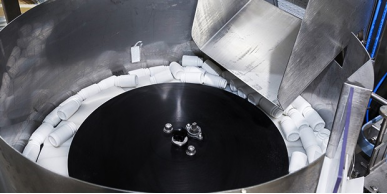
Align Equipment Choice with Container Configurations
Optimizing a feeding line begins with matching machinery to the characteristics of the containers being handled.
When evaluating an automatic bottle unscrambler, engineers must consider specific physical attributes, including geometric profiles (whether round, square, or custom asymmetrical silhouettes), plastic material density, and the full dimensional spectrum of the product portfolio.
Selecting an incompatible sorting setup may lead to operational challenges, such as frequent changeover delays, recurrent physical blockages, and surface abrasions or structural damage to delicate plastic walls.
Implementing a versatile, high-performance solution engineered for multi-format production helps mitigate these vulnerabilities, providing a stable supply of containers to primary processing zones.
Streamline Hopper Dynamics and Pre-Sorting Zones
The performance of a bottle unscrambling machine depends heavily on how smoothly materials flow through its initial storage hopper and elevator feed zone. Production lines frequently encounter two distinct material delivery problems: overloading and underloading.
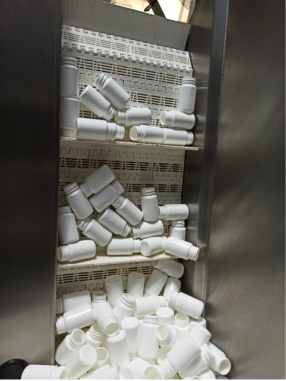
l Overloading causes excessive bulk pressure, leading to tight jams within the sorting mechanism.
l Underloading starves downstream systems, causing costly production gaps.
Best Practices:
(1) Integrate Level Sensors: Utilizing ultrasonic or capacitive sensors keeps the hopper feed steady and automated, removing the need for constant manual monitoring.
(2) Round the Hopper Corners: Sharp 90-degree corners allow bottles to bridge and stick. Implementing rounded interiors lets gravity do its job, so plastic containers slide down smoothly without nesting or wedging.
A steady buffer sustains a continuous flow to the unscrambling wheel while reducing the risk of container damage.
Implement Gentle Moving Mechanisms
Maintaining pristine aesthetic and structural quality is essential in regulated pharmaceutical environments.
To prevent friction damage, micro-scratches, or structural deformations during sorting, manufacturers must utilize sophisticated, low-impact manipulation techniques.
High-quality systems substitute rough contact points with specialized low-friction composite guide rails that allow components to slide effortlessly.
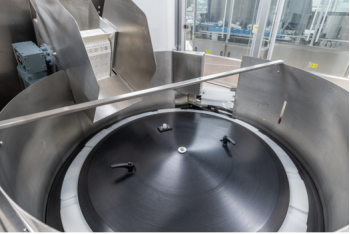
Additionally, integrating smart variable-frequency drives enables soft-start and soft-stop acceleration profiles, limiting impacts during sudden speed adjustments.
Minimizing structural drop heights between sorting discs and outfeed tracks also reduces impact stress, keeping lightweight containers upright and less prone to damage.
Establish Seamless Integration with Downstream Units
A high-speed bottle unscrambler cannot operate effectively as an isolated system; it must communicate dynamically with the entire production line. Achieving true synchronization requires precise control over three interconnected parameters:
First, delivery speeds must match downstream processing rates exactly; over-speeding causes chaotic accumulation jams, while under-speeding starves the filling line.
Second, utilizing a uniform outfeed discharge height minimizes vertical transitions that may cause light containers to tip over.
Finally, installing upstream and downstream interlock signaling loops creates a responsive network. When a downstream capper or counter encounters an issue, the unscrambler automatically stops operation, preventing blockages before they happen.
Prioritize Preventive Maintenance and Sensor Calibration
Long-term reliability requires strict adherence to a dedicated preventive maintenance program. The mechanical and optical components of an automatic bottle unscrambler require routine inspections to counter natural wear and tear.
Maintenance teams should focus heavily on keeping sorting discs, orientation pockets, and discharge pathways clear of dust and debris.
Optical track sensors require routine calibration checks to ensure reliable detection performance.
Furthermore, technicians must perform periodic tension checks and alignment verifications on timing belts and synchronized gripping belts to prevent slippage and facilitate smooth container transfers.
PHARMAPACK Bottle Unscrambler
For manufacturers seeking a dependable, high-efficiency system that incorporates these best practices, our PHARMAPACK LFU-25C is a reliable option.
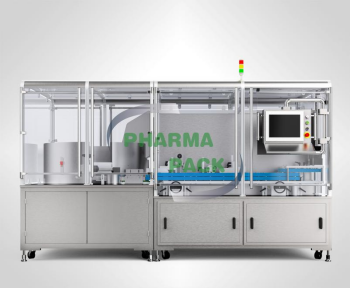
Engineered to meet stringent GMP requirements, this high-speed bottle unscrambler delivers a maximum throughput of 250 bottles per minute, supporting demanding production schedules.
The LFU-25C handles a wide range of sizes, accommodating round and square bottles from 25 mm to 100 mm. Its compact footprint integrates seamlessly into cleanroom environments without sacrificing valuable floor space.
Notably, the machine simplifies format transitions; only the pre-sorter disc requires adjustment during changeovers. This quick-change design reduces setup downtime and provides modern facilities with greater operational flexibility.
FAQ
1. How does a bottle unscrambler deal with dust drawn in by static electricity?、
An optional ionized-air cleaning unit can be integrated to neutralize static charges and remove debris from inside bottles during the sorting process, all in a single pass.
2. What happens to inverted or backward bottles heading downstream?
As an optional configuration, dual-sensor detection can be added at the outfeed to read both height and base profile, paired with a high-pressure air jet to reject incorrectly oriented bottles. The rejection point should empty into a lockable reject bin, which keeps stray bottles from contaminating the correct batch.
For more information on optimizing your production lines, explore our comprehensive automated solutions.